Rational Number
This chapter introduces positive and negative numbers through real-life examples such as temperature and budgeting, and develops students’ understanding of rational numbers, number lines, opposite numbers, absolute value, and methods for comparing rational numbers.
Thu May 07
Positive and Negative Numbers
Think about this: are there any numbers smaller than 0 in the real world?
For example, on a thermometer we can see 25°C and 0°C, but we can also see -5°C and -20°C.
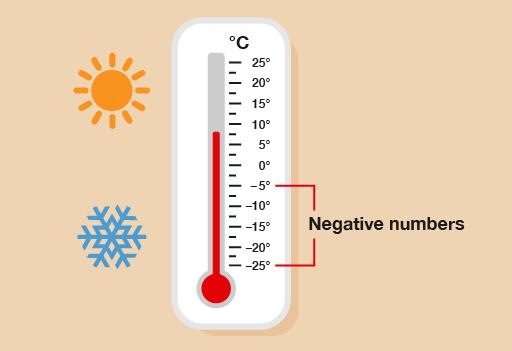
From the thermometer example, we can see that numbers below 0 have a “−” sign in front of them. Numbers smaller than 0 with a minus sign are called negative numbers.
Similarly, numbers greater than 0 are called positive numbers. The “+” sign of a positive number is usually omitted. If a number has no sign, it is usually considered positive. For example, 5 actually means +5.
0 is neither a positive number nor a negative number.
0 is the boundary between positive and negative numbers.
Using Positive and Negative Numbers to Represent Opposite Quantities
When using positive and negative numbers to represent quantities with opposite meanings, either meaning can be chosen as positive. Once one quantity is represented by a positive number, the opposite quantity is represented by a negative number, and vice versa.
For example, if we earn 5 dollars, we record “+5” in our account book. If we spend 5 dollars, we record “-5”. Many budgeting apps visualize income and expenses in this way.

Another example:
Moving forward 5 meters is represented as “+5”, while moving backward 5 meters is represented as “-5”.
Example:
If 12 noon is recorded as 0, and 3 p.m. is recorded as +3, then 11 a.m. should be recorded as ____.
Explanation: 3 p.m. is 3 hours after 12 noon, so it is recorded as +3. 11 a.m. is 1 hour before 12 noon, so it is recorded as -1.Rational Numbers
Definition of rational numbers:
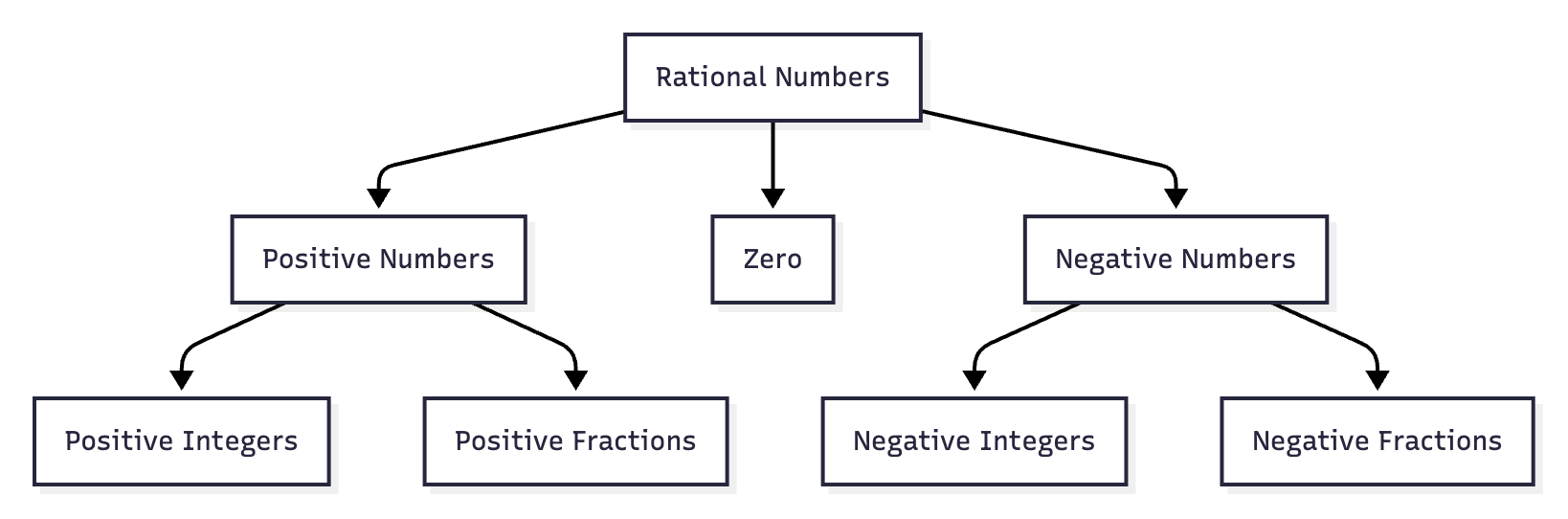
Positive integers, 0, and negative integers are collectively called integers.
Positive fractions and negative fractions are collectively called fractions.
Integers and fractions together are called rational numbers.
Rational numbers include only integers and fractions. Non-repeating infinite decimals are not rational numbers.
The classification of rational numbers is shown below:
Number Line
Definition of a number line:
In mathematics, numbers can be represented by points on a straight line. This line is called a number line, and it satisfies the following conditions:
- Choose a point on the line to represent 0. This point is called the origin.
- Usually, the direction to the right (or upward) from the origin is defined as the positive direction, while the direction to the left (or downward) is defined as the negative direction.
- Select a suitable unit length. Starting from the origin and moving to the right, points represent 1, 2, 3, ... ; moving to the left, points represent -1, -2, -3, ...

Numbers on the left side of the origin are negative numbers, while numbers on the right side are positive numbers.
Fractions and decimals can also be represented on the number line.
The figure below shows examples of numbers on a number line.

- Point A represents -4.5
- Point C represents -2
- Point D represents 0 (the origin)
- Point B represents 3
In this diagram, the positive direction is to the right (which is usually the case).
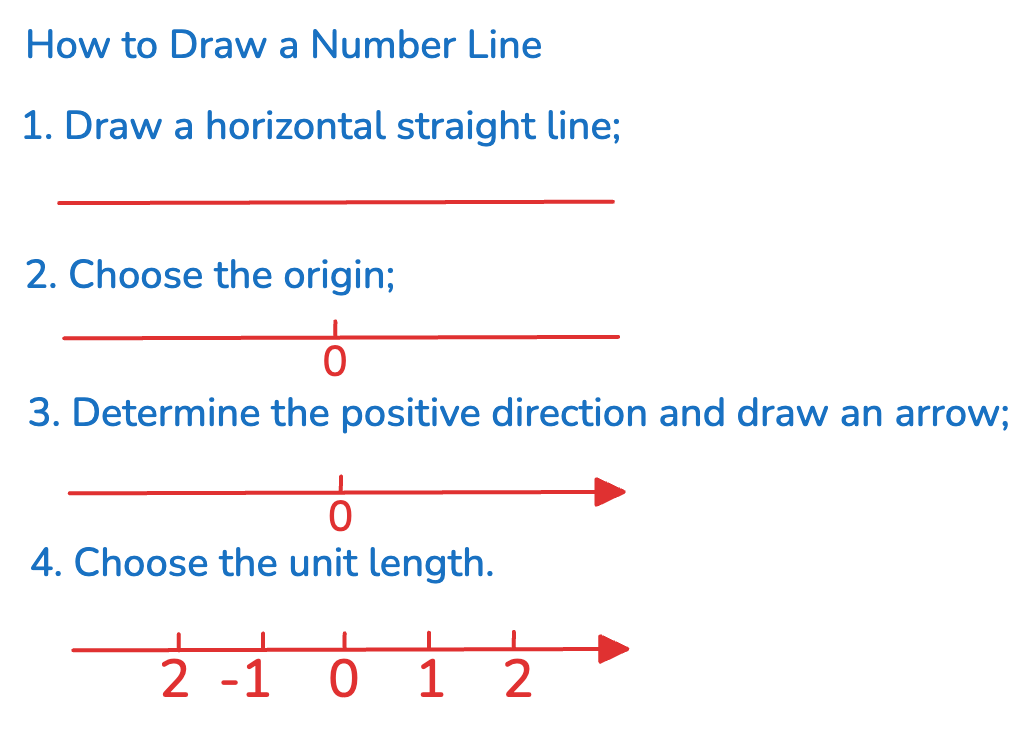
The three essential elements of a number line are:
- Origin
- Positive direction
- Unit length
Points on the Number Line and Rational Numbers
In general, let be a positive number.
Then:
- The point representing lies on the right side of the origin, and its distance from the origin is units.
- The point representing lies on the left side of the origin, and its distance from the origin is also units.

For example, both 6 and -6 are 6 units away from the origin.
Opposite Numbers
Concept
Numbers such as 2 and -2, or 5 and -5, which differ only in sign, are called opposite numbers.
In general, and are opposite numbers.
In particular, the opposite number of 0 is 0.
Here, can represent any number: positive, negative, or zero.
Geometric Meaning
Two opposite numbers correspond to points on opposite sides of the origin and at equal distances from the origin.
Conversely, if two points are on opposite sides of the origin and equally distant from it, then the numbers they represent are opposite numbers.
In this figure, 6 and -6 are opposite numbers, and both are 6 units away from the origin.
Properties
Every number has exactly one opposite number.
- The opposite of a positive number is negative.
- The opposite of a negative number is positive.
- The opposite of 0 is still 0.
The sum of two opposite numbers is 0.
Example:
The opposite number of -2 is ___.
Explanation:
According to the definition, the opposite number of -2 is 2.
Absolute Value
Definition
In general, the distance between the point representing number and the origin on the number line is called the absolute value of , written as .
Examples:
Algebraic Meaning
- The absolute value of a positive number is itself.
- The absolute value of a negative number is its opposite number.
- The absolute value of 0 is 0.
That is:
- If , then
- If , then
- If , then
Using piecewise notation:
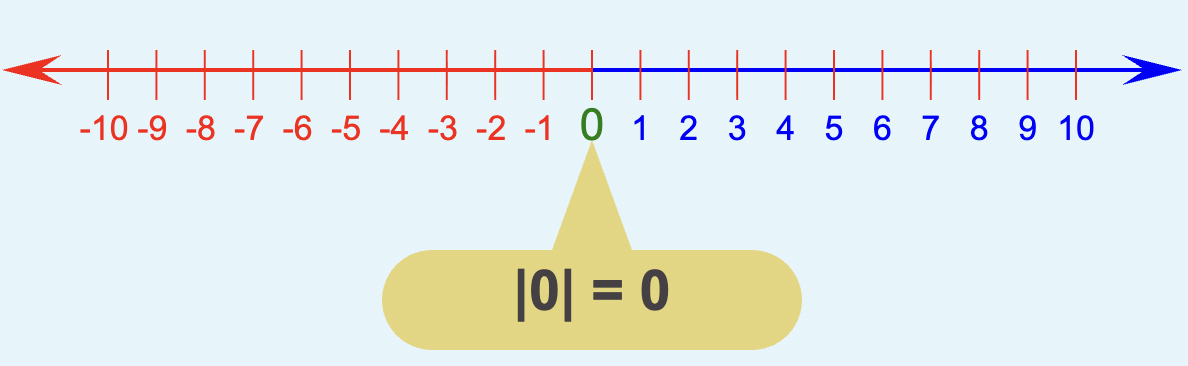
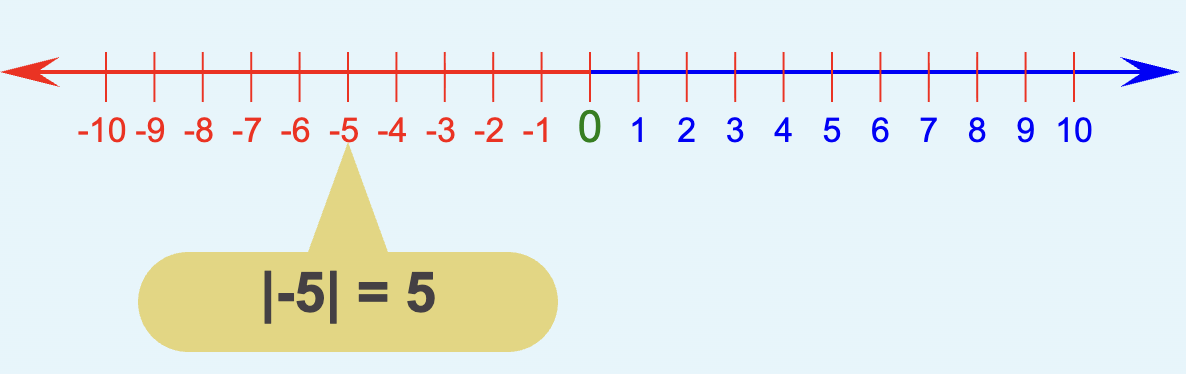
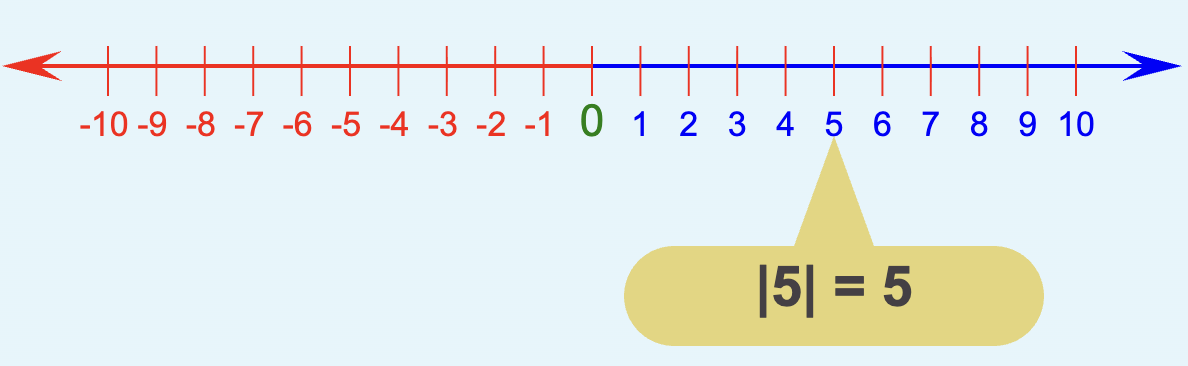
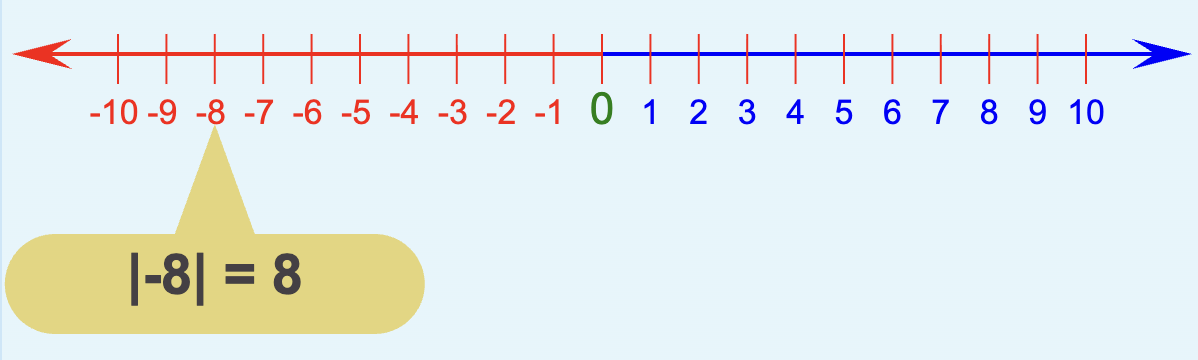
The following figures illustrate examples of absolute value:
Geometric Meaning
The absolute value of a number represents the distance between the point corresponding to the number and the origin on the number line.
- The farther a point is from the origin, the greater its absolute value.
- The closer a point is to the origin, the smaller its absolute value.
Therefore:
- If a number is positive or zero, we keep it unchanged.
- If a number is negative, we use to make it positive.
Example:
What is ?
Since , we calculate:
Therefore:
Here we use the rule:
“Negative times negative gives positive.”
Properties
Absolute value is always non-negative:
If the sum of several absolute values equals 0, then every number must be 0.
Suppose we have several numbers :
Then:
Example:
Find the absolute value of -7.
Explanation:
If:
then:
or
Comparing Rational Numbers
Using the Number Line
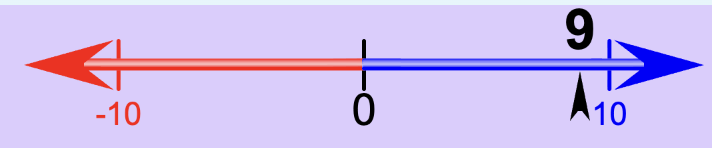
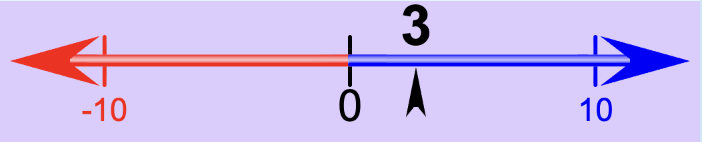
On a number line, the order of numbers from left to right is the order from smallest to largest.
That is:
Numbers on the left are smaller than numbers on the right.
For example, when comparing 9 and 3, we can see that 3 is on the left side of 9, so:
Using Rules
- Positive numbers are greater than 0.
- 0 is greater than negative numbers.
- Positive numbers are greater than negative numbers.
When comparing two negative numbers:
The number with the greater absolute value is actually smaller.
Suppose and are two negative rational numbers.
Then:
For example, compare -5 and -8.
Since both numbers are negative, we compare their absolute values:
Since:
and the negative number with the larger absolute value is smaller, we have:
Using the number line, we can also see that -8 is on the left side of -5, so:
Originally published at mathnest.top by Penny Zhao.
Comments
No account needed — just leave your name and comment.